DMR and APRS tracking
Digital Comms Connector: Development Update
It’s been a while since our last update on Digital Comms Connector, but development has continued behind the scenes.
The software allows our event control room to capture and bring together audio, messages and position-tracking data from the communications systems used during events we support even when there is no Internet available. This information is important to the control team, so reliability and accuracy are essential.
We’ve made progress across the communications interfaces and the event management app. Here’s an update on what’s available, what’s supported, and what we’re working on next.
MMDVM custom firmware
We’ve released the code and custom firmware needed to allow an MMDVM board to receive transmissions from a Tier 2 DMR repeater.
The source code is available on GitHub:
There is also a version for MMDVM_HS boards:
- MMDVM_HS: https://github.com/rob-uk-hub/MMDVM_HS
MMDVM_HS boards have very limited receive performance, but can still be useful for development and testing, or when operating close to the repeater.
Both projects are released under the GPLv2 licence.
Digital Comms Connector
The majority of the code responsible for decoding digital communications data is now available through our GitLab projects:
- Project collection: https://gitlab.com/digital_radio
- Main application: https://gitlab.com/digital_radio/digital_comms_connector
The code has been split into four reusable modules, making it easier to work with individual components and potentially incorporate them into other projects.
The projects are released under the GPLv3 licence. We welcome contributions, testing and feedback from anyone interested in helping develop the software.
Documentation still needs further work, and additional features are planned. The current implementation supports the following.
Supported communications and data
Digital Mobile Radio (DMR)
DMR data can be received using either our custom MMDVM/MMDVM_HS firmware or Open DMR Terminal. Supported data includes:
- DMR audio
- SMS messages
- GPS position reports via D-APRS
Analogue APRS
Data can be received through a KISS-compatible TNC or an APRS Internet Service (APRS-IS) connection. Supported information includes:
- Position reports
- Messages
- Weather data
Equipment compatibility
Testing so far has covered the following radios:
- Anytone AT-D878, AT-D890 and AT-D578: DMR audio, SMS messages and position reports.
- OpenGD77: DMR audio. Position reporting is not yet working.
- TYT MD-UV380: DMR audio only.
Compatibility can vary between radio models and firmware versions. Further testing and updates will follow as more equipment becomes available.
DMR encryption is not currently supported. We may investigate this in the future, particularly to explore potential use in emergency-response roles, subject to the relevant technical and operational requirements.
Planned improvements
There are several areas where we’d like to extend the software:
- Audio transcription: Convert recorded speech into text to make event logs easier to review and search.
- MeshCore integration: Support private position reports and messages from MeshCore.
- Support for additional DMR radios: Extend compatibility to other manufacturers. GPS position data is not consistent across all radios, so access to additional hardware is important for development and testing.
- Data encoding: Extend the reusable modules to encode data as well as decode it, potentially enabling additional features and applications in the future.
Event Comms app
The Event Comms app is the interface our control team uses during events to view information collected by Digital Comms Connector. It brings together the latest communications data with planned event details and operational logs, helping the team maintain an overview of what is happening.
The app is one of the largest areas of ongoing development. If you know of an existing application that supports offline operation and can display this type of communications data, we’d love to hear from you. Using an existing solution could significantly reduce the amount of development and maintenance required.
Bringing Event Comms to the web
The next major update has taken a little longer than expected, partly because new feature requests have expanded its scope!
One of the main goals is to make important event information available to authorised users who are away from the control room, while retaining the ability to operate when an Internet connection is unavailable.
The planned deployment options are:
- Android: Supported, including phones, tablets and ChromeOS devices.
- Windows: Not yet tested.
- Web: A browser-based interface is being developed.
- iOS: Not currently supported. Adding it would require further development and hardware investment, but may be available in the future.
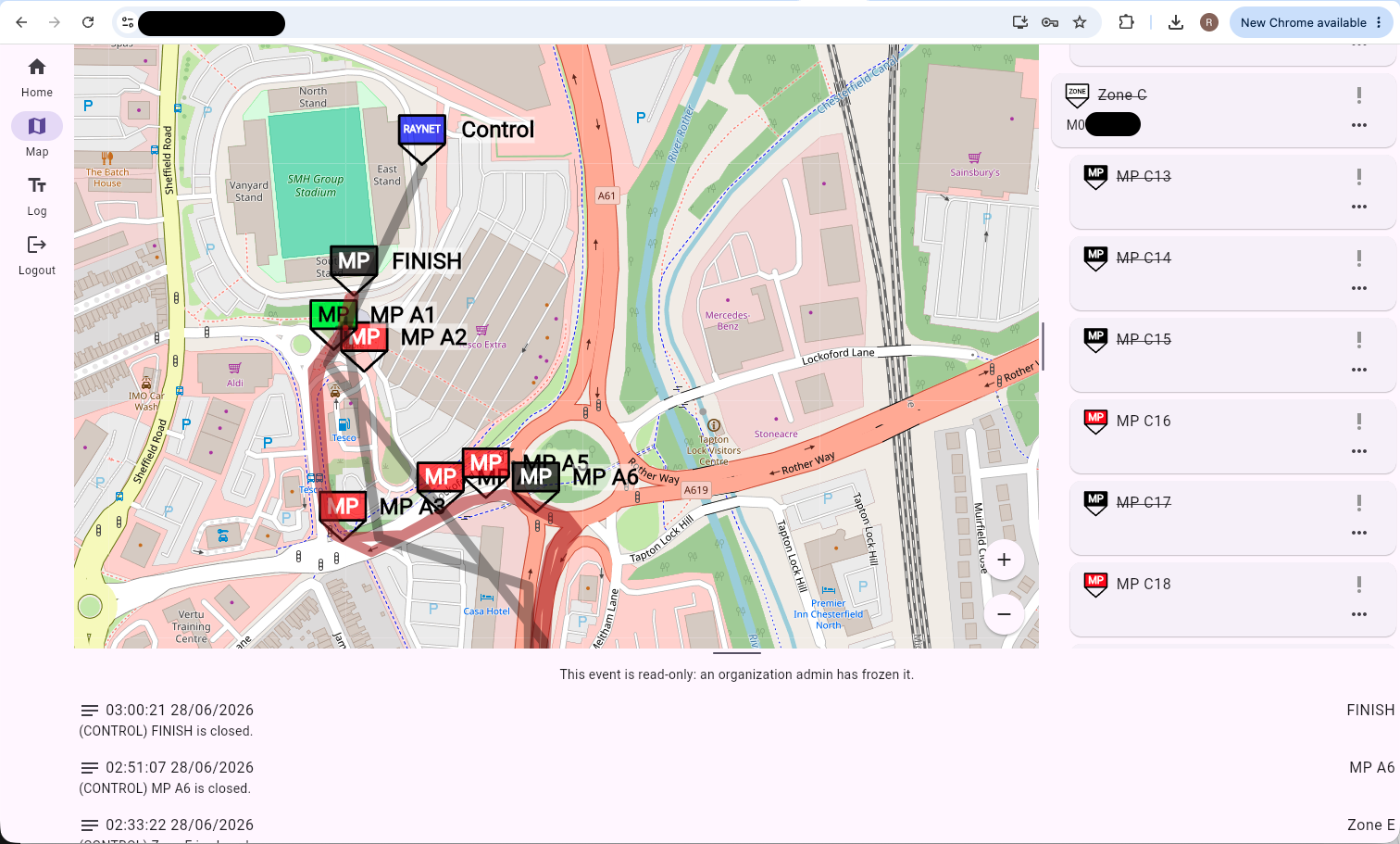
The web interface introduces an important technical challenge: keeping information synchronised between devices without making the control room dependent on an Internet connection.
Our approach is to support synchronisation between devices. This will allow the control room to continue using the desktop app independently of the Internet, while remote users can access the latest available information over the Internet when a connection is available.
This should give us the flexibility to support both self-contained event control operations and wider information sharing.
Example screenshot of the web version:
What happens next?
The core functionality is now in place, but there is still significant testing to complete, particularly around synchronisation. Ensuring that information remains consistent across devices, including when connections are interrupted and restored, is an important part of making the system dependable enough for operational use.
We’ll continue developing and testing the app before making the updated version available.
We’ll share further updates as the work progresses. In the meantime, feedback, contributions and offers to test with additional radio equipment are all welcome.